I.1 Om
The syllable in the Upaniṣads
Om is the sacred syllable of the Vedic and Upaniṣadic traditions of India, sounded at the beginning and the end of recitation, prayer and study to this day. The Chāndogya Upaniṣad opens by telling the student to meditate on the syllable Om as the udgītha, the syllable on which the chant of the Sāma Veda is sung (Chāndogya Upaniṣad I.1.1). The Taittirīya Upaniṣad gives a short teaching in which Om is named Brahman and all this world, and in which the priests begin their chants and their offerings with it (Taittirīya Upaniṣad I.8). In the Kaṭha Upaniṣad Death himself teaches the boy Naciketas that the word which all the Vedas declare, for which seekers keep their austerities and the discipline of the student, is Om (Kaṭha Upaniṣad I.2.15 to 16).
The Māṇḍūkya Upaniṣad, the shortest of the principal Upaniṣads, opens by saying that Om is all this, what was, what is and what will be, and whatever lies beyond the three times as well (Māṇḍūkya Upaniṣad 1). The same Upaniṣad then divides the syllable into its parts. The sound A is the waking state, the sound U is the dreaming state and the sound M is deep sleep, and the fourth part has no sound at all (Māṇḍūkya Upaniṣad 8 to 12). That silent fourth is Turīya, pure consciousness, the background that sustains the three states and passes beyond them. Our Central Doctrine reads these four states through its own model of the self (Central Doctrine, Ch. 59, §59.25).
| Part of the syllable | State in the Māṇḍūkya | Our School's reading |
|---|---|---|
| A | Waking (jāgrat), consciousness turned outward through the senses | The observing "I" at work in the world |
| U | Dreaming (svapna), consciousness creating its own inner world | The imaginal stratum entered in the rite |
| M | Deep sleep (suṣupti), consciousness withdrawn into itself without duality | The undifferentiated ground beneath every content |
| The silence after the M | The Fourth (Turīya), the Self, one with Brahman | The Singularity known from within, the indestructible waking state |
Verse 7 of the Māṇḍūkya describes the Fourth as unseen, beyond speech and thought, without attributes, the peaceful, all bliss and the non-dual, the Self that has to be realized. Aleister Crowley, one of the first doorways into my own exploration of the Western mysteries, gave the West a near image of that Fourth in Hadit of The Book of the Law, the point that has position and no magnitude, the core of every being, who says, "I am alone: there is no God where I am." In our School the Fourth is the Singularity known from within, the observing "I" resting as the center it has always been, and we call it the indestructible waking state (Central Doctrine, Ch. 59, §59.25).
The written syllable carries the same teaching. In a common modern Indian reading of the sign ॐ, its three curves stand for the three states that the syllable names, its crescent for the veil of illusion that divides them from the Fourth, and its point for the Fourth itself, the Self that the three states veil and that no state contains.
Two other scriptures carried the syllable into the practice of the yogi. In the Bhagavad Gītā Kṛṣṇa teaches that whoever leaves the body sounding Om, the one syllable that is Brahman, and remembering him, reaches the highest goal (Bhagavad Gītā 8.13). Patañjali, in the Yoga Sūtras, names the sacred syllable, the praṇava, as the word that expresses the Lord, and he gives its repetition, with meditation on its meaning, as a practice for the yogi (Yoga Sūtras I.27 to 28). Our own students first sound the syllable in that same seat, in the Meditation of Unity.
In later Hindu teaching the three sounds are also given to the three great works of the Cosmos, creation, preservation and dissolution, the offices of Brahmā, Viṣṇu and Śiva, and the silence after them is the transcendence that holds all three. To sound Om with attention is to pass through that whole cycle in a single breath, from the open A in the chest to the closed M in the head and into the quiet that follows.
How I came to the sound
My own first teacher in the power of vibration was a small Hermetic book. At eighteen, after Summum: Sealed Except to the Open Mind led me back to The Kybalion, I read The Kybalion over and over until its sentences were part of how I thought, and much of my first disciplined meditation drew on its seven principles. Its third principle, Vibration, teaches that nothing rests and everything moves and vibrates, and that a mental state, like a musical tone, can be reproduced by making the instrument vibrate at a certain rate. In WaveForm Astrology we still open our teaching of the solar frequency with that Hermetic principle and its two words, rate and mode (WaveForm Astrology, Ch. 5, §5.8.2).
From eighteen to twenty-two I attended every event I could at the Summum Pyramid in Salt Lake City, progressed through all of Summum's required programs and was formally initiated into the order. There I first learned of Osho, and Osho Rajneesh stands among the teachers of the East from whom our School draws, beside A. C. Bhaktivedanta Swami Prabhupāda, Ramakrishna and Shambhavi Chopra (Central Doctrine, Ch. 4, §4.2.1).
In 1996 I enrolled at UCMT, the Utah College of Massage Therapy in Salt Lake City, and the second great influence of those years was my Kundalini Yoga instructor, whose sessions I attended every day after classes for a full six months (Part V, §V.5). From the Tantric years that followed I kept Raja Kundalini, the union of Rāja yoga with Tantric Kuṇḍalinī, and I have practiced it ever since. Today our School teaches it as the preparation of the vessel, and Om is the mantra of its principal seated meditation.
In the ceremonial tradition that Israel Regardie taught, the god-name is vibrated, breathed in, sent through the whole body and let go, so the body sounds as the instrument of the Name. I vibrated the Names in this way in the banishings and Middle Pillar workings I performed from my first chamber onward. Regardie gave the sign by which a practitioner may know that a Name has been sounded truly: "If the whole body of the Magician feels aflame with force and energy, and thundering in his ears from every surrounding portion of space he hears the resounding echo of the name just magically vibrated, he may rest assured that the pronouncement has been correctly accomplished" (Israel Regardie, The Tree of Life, quoted in Ritual Praxis and Instruction, Ch. 20, §20.2.5). In our School the fire and the thundering echo do come once the octaves are fully established, as I have seen many times in my students.
The sound of the One
Many traditions of sacred sound teach that the world itself began as a sound. Algis Uždavinys, whose studies of the Egyptian and Neoplatonic roots of theurgy inform our understanding of sacred sound, gives the doctrine in these words: "The light-like primordial sound, pronounced by the supreme Creator or the Ennead of gods is characterized by miraculous force; therefore the world is this transcendent sound and the living (ankh) noetic (akh) image (tut) made substantial" (Ritual Praxis and Instruction, Ch. 20, §20.1.1, quoting Uždavinys, Philosophy as a Rite of Rebirth, 2008). The Tantras teach the same thing as Nāda Brahman, the Cosmos as divine sound, and our Central Doctrine gives it to the Goddess's gift of knowledge, the order of the heavens as a speech to be read (Central Doctrine, Ch. 59, §59.29).
The Upaniṣads give sound the office of a light. In the Bṛhadāraṇyaka the sage Yājñavalkya tells King Janaka what serves a man as light when the other lights are gone: "Sound indeed is his light; for, having sound alone for his light, man sits, moves about, does his work, and returns. Therefore, O King, when one cannot see even one's own hand, yet when a sound is raised, one goes towards it" (Bṛhadāraṇyaka Upaniṣad IV.3.5 to 6, trans. F. Max Müller, quoted in Ritual Praxis and Instruction, Ch. 20, §20.1.5). The teaching of śabda brahman, that the Absolute is in its nature sound and the Cosmos its utterance, has its seat in the throat center of our Raja Kundalini. The same teaching stands at the head of the Western tradition in the Logos of the Gospel of John and of the Platonists, through which all things were made (Ritual Praxis and Instruction, Ch. 7, §7.4.5).
For our School, Om is the sound-form of the Infinite, the pure tone of the archetype of the One that is All and the All that is One. Our Divine Infinite Being has three names in one, Infinite for the Singularity at the center, Divine for the cosmic horizon at the circumference and Being for the living geometry between them (Central Doctrine, Ch. 22, §22.17). Om is that whole Being heard as one vibration, the center, the horizon and everything between them sounding together in a single breath.
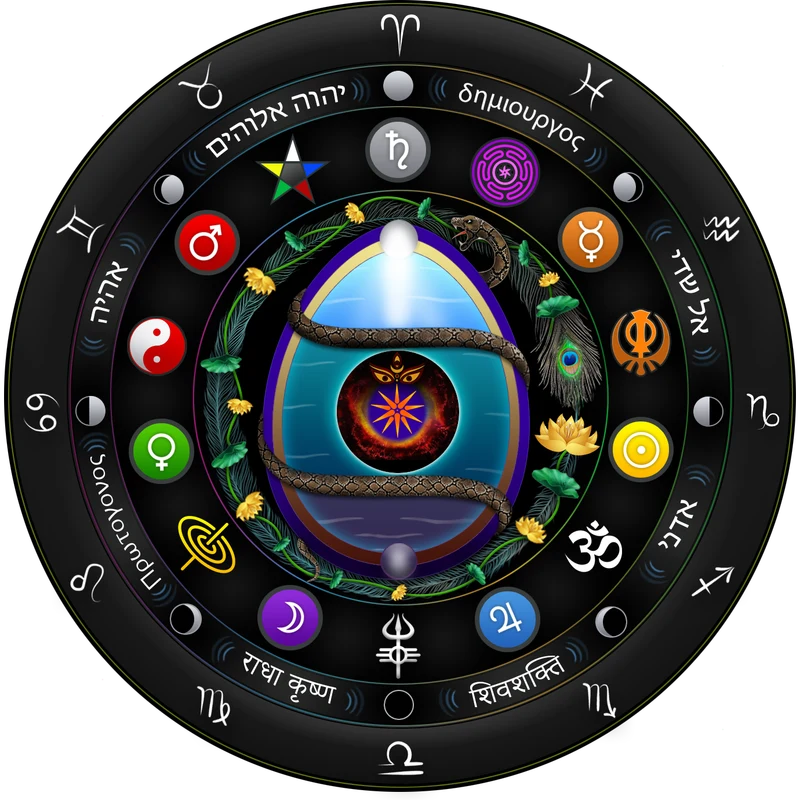
Our emblem, the mandala, is the Self/God archetype, the center that is also the circumference, and every symbol of our School is one face of that archetype (Central Doctrine, Ch. 3, §3.11). We read the whole mandala as Om given form, the one sound spread out as Names, gods, planets and powers about a single center. When you sound Om with attention you gather that whole circle back into one sound, with the microcosm and the macrocosm standing in one order.
Om and the Names of the rite
The Divine Names of our rite are sounded inside this vibration. Iamblichus taught that the gods have sown their tokens, the sunthēmata, through the whole world, in stones, plants, numbers, images, motions and sounds, and that the Names are among the most potent of them. Each Name of the Grand Invocation gives the One a particular office: 'Ehyeh the unitary ground, YHVH the omnicentric center, Elohim the spherical cosmic horizon, Helios the solar center and the body of light, and Protogonos the union of the center with the Divine Double (Ritual Praxis and Instruction, Ch. 20, §20.7.1). We hear all of them, with every other Name of the rite, as the one resonance of Om given its many faces.
Gregory Shaw teaches that in Tantra and in theurgy alike the initiate enters the god's "body" through rite, by the chanting of mantras in the one and of divine names in the other, and that by entering the god's audible body the initiate becomes that god in embodied form. A mantra, for the Tantras, is the deity in the form of sound. In our Raja Kundalini, Om and the seven seed syllables are mantras in that strict sense, and they train the body that will later carry the Names of the theurgic rite (Ritual Praxis and Instruction, Ch. 5, §5.3.3). Our governing formula is that Raja Kundalini prepares, theurgy unites and Solar Salvation completes (Ritual Praxis and Instruction, Ch. 5).
The voice itself shows the kinship of Om and the Names. Elohim closes on the humming "m", felt resonating in the skull and through the whole head, and the same hum ends Om. In our Raja Kundalini every seed syllable of the body closes on that hum, and at the crown only the hum remains, the sound of every center gathered into one sound that passes into silence (Ritual Praxis and Instruction, Ch. 7, §7.4.7).
Divine Names are used in three ways across the mystery schools and religious systems of the world. In some they are melodic, sung as a phrase with a tune, and in others they are chanted many times in a deep, circling voice that loosens the ordinary mind by rhythm and repetition. Our way is the third, the theory of octaves, a single sustained sounding, or at most three, in which the voice holds one tone steady and the attention climbs within it (Ritual Praxis and Instruction, Ch. 20, §20.1.3). The first octave is your own voice given fully, the second is its octave heard above it as the tuning instrument, and the third is "the octave that does not exist", attended to beyond hearing (Ritual Praxis and Instruction, Ch. 20, §20.2.4). Om is the first syllable on which our students learn that method, alone and in silence, before they sound a Name in the temple.
There is no prescribed note. You sound Om at your own natural resonant pitch, usually somewhat lower than the speaking voice and never forced down, the pitch at which the voice rings with least effort and the body vibrates most freely. In time most of my students find that a strong, sustained, unhurried tone serves best, and that the temple itself, especially once it has been consecrated by repeated rites, truly begins to answer the voice (Ritual Praxis and Instruction, Ch. 20, §20.2.2).
Om in the Meditation of Unity: the one and the zero
The Meditation of Unity is our principal seated meditation of Raja Kundalini, and Om is its mantra. It holds the witness as absolute unity, the one, together with the boundless openness that surrounds it, the zero, and it trains the mind and the breath to rest at once in Being and in boundless Non-Being. A sitting lasts eight to fifteen minutes, and twenty to thirty in advanced practice. In the first grade, the Aspirant, under Hermes, every student completes at least twelve Meditations of Unity among the forty recorded sessions of Raja Kundalini that the grade requires (Ritual Praxis and Instruction, Ch. 1, §1.4).
You sit upright on a cushion or a chair, with the spine tall, the crown gently rising, the shoulders soft, the jaw unclenched and the tongue resting on the palate, thumb and index finger lightly joined in chin mudrā. You settle the breath and attend to the felt sense of "I am aware." At the crown of the head you see the one, a luminous, perfectly focused point, and you let it become your identity, while a boundless dark openness surrounds it in every direction. On each exhale you sound Om, for six to ten seconds or any length that stays relaxed, and let the light of the one press gently outward into the zero without losing its point. On each inhale, through the nose, you gather all the radiance back into the point (Ritual Praxis and Instruction, Ch. 5, §5.9).
After three to five such breaths you rest in silence for three deep breaths, with no mantra and no effort, abiding as the one within the zero. Then you begin another round or close, letting the mantra and the image dissolve, feeling the after-glow of centered clarity and bowing inwardly to the Witness. Those who work with the Kabbalistic parallels may take the point as Kether, absolute unity, enthroned in Ain, the Nothing beyond every attribute.
In this concentration the "I" is stabilized as the axis of the whole field. Every appearance that rises in the mind, every thought, every projection and every turbulence of feeling, is allowed to appear and pass as an empty zero that does not touch the point. If the mind wanders, you find the one again at the crown. If you strain, you ease the throat and jaw and shorten the Om, and if you grow dull, you brighten the point a little and sit a little taller (Ritual Praxis and Instruction, Ch. 5, §5.9.2).
The Om is intoned unforced and even, at moderate volume, with enough clarity that the second octave can be heard above the voice. As it fades into the silent holding at the end of the round, you stand at the place we give to the third octave, the threshold at which sound gives way to the silence it came from, the edge of the zero (Ritual Praxis and Instruction, Ch. 5, §5.9.1). In that silence you enter by practice the fourth part of the syllable in the Māṇḍūkya.
What the meditation rehearses
The two images of the meditation are the two poles of our cosmology. The one is the center of YHVH, the Yod from which the letters of the Name proceed, the solar seed known at Helios and the Infinite of our Divine Infinite Being. The zero is Elohim, the infinite spherical enclosure, the cosmic horizon, the Divine, and in the microcosm it is the rim of the ochēma, the soul's spherical vehicle (Ritual Praxis and Instruction, Ch. 5, §5.9.3). Within WaveForm Astrology the one is the solar center, the invariant reference of the microcosm, and the zero is the boundary that encloses the operators.
The exhale that radiates the one into the zero is the center expanding to its horizon, and the inhale is the horizon returning its potency to the center. In this way the meditation rehearses in the seat the second stage of our ladder, the union of Center and Horizon, before the student performs it in the rite. The same breath shows in its simplest form how the light of the One is given whole in the point and spread into the field, breath by breath, from our Divine Infinite Being, the one source of every light.
Om in the body: the brow and the crown
In our Raja Kundalini each of the seven embodiments has its own seed syllable: Lam at the root, Vam at the sacral center, Ram at the solar plexus, Yam at the heart, Ham at the throat and Om at the brow, with the closing hum alone at the crown. The brow center is Ājñā, the center of "command", between the eyebrows and a little above, indigo, the seat of mind beyond the five elements. Its pronouncement is "I see clearly through the Eye of the Spirit. I am vision", and Om is resonated three times, with a deep breath and the Sign of Silence between each sounding (Ritual Praxis and Instruction, Ch. 7, §7.4.6).
Ājñā has two petals, the two currents of iḍā and piṅgalā meeting at their end, and here the two eyes of ordinary sight give way to the single eye of vision. The octave that rings above the voice in the Meditation of Unity becomes, at the brow, a light that shines behind the eyes, the inner sun behind all appearances. Here the inner Witness, sākṣin, becomes clear, the same Śiva the student first met at the end of the withdrawal in our Raja Kundalini, met again at the top of the ascent (Ritual Praxis and Instruction, Ch. 7, §7.4.6).
The vibration of Om rises along the central channel to the crown, Sahasrāra, the thousand-petalled lotus, visualized as a field of light above the head. The crown has no seed syllable of its own. Its resonance is the nasal hum itself, ng passing into m, the sound with which every seed syllable below it ends, felt at the top of the skull and above it. Its pronouncement is "I am one with all life. I am That. I am the Light itself", the great saying of the Upaniṣads, tat tvam asi, "That thou art", turned into the first person and spoken only from the observing "I" (Ritual Praxis and Instruction, Ch. 7, §7.4.7).
The rite itself opens at the brow. Its first act, before any Name is sounded, is the laying of a finger to the center of the forehead while the brilliant white light is built above the head, and I begin every rite I perform in this way (Ritual Praxis and Instruction, Ch. 7, §7.4.6).
Om on the cards and in our astrology
In The Divine Arcana Tarot the sign of Om stands behind the Orphic egg on the card of the Fool, numbered zero. The card shows Dionysus and Phanes-Protogonos as one figure leaping from a cliff, and the sound stands behind the shell as the beginning that comes before the egg, the creation that Phanes brings into the light when the shell opens (The Divine Arcana Tarot, Ch. 14, §14.3). The Fool shows the order of the three in one picture, the sound before any boundary, the egg as the boundary and the figure who steps out of the boundary's old rule.
Within WaveForm Astrology, frequency is the invariant rest reference of the microcosm, and the Sun is the chart's key frequency, the fundamental to which every operator frequency is tuned (WaveForm Astrology, Ch. 29, §29.11.2). Its signature is quiet, non-anxious knowing, and a steady solar reference shows itself as calm (WaveForm Astrology, Ch. 5, §5.8.2). Om is sounded in that same way, unforced, even and at moderate volume.
Henry Stapp's account of a quantum state that is probed again and again and held ever more stably, the dynamic physicists call the quantum Zeno effect, is the image WaveForm uses for this holding (WaveForm Astrology, Ch. 5, §5.8.2). Each Om is one more act of attention on the center. Repeated daily, it lowers the effort needed to find the key frequency again in the middle of a working day, and after many mornings the octave is already there when the voice begins.
Om and its kindred symbols
Om belongs with the Sun, the visible body of the god whose seed is the one of the Meditation of Unity, and with the planets, which all stand under Apollo, the personality of the Sun, as operators tuned to the one key frequency (Part V, §V.2). It belongs with Jupiter, the god who enlarges the horizon of what a life can include, the boundary operator that widens the radius of the vehicle as the sounding of Om widens the one into the zero (Central Doctrine, Ch. 6, §6.8). The hum of Om in which every center passes into silence belongs with Śiva, the motionless witness, as the dance belongs with Śakti (Part V, §V.5). The Names of our rite, 'Ehyeh, YHVH Elohim, El Shaddai and Protogonos among them, are the faces of the one resonance (Part II). Om is the One heard, and Yin and Yang is the One known in its pair of poles (§I.2).
Plain answers to common misunderstandings
Some ask whether Om belongs to Hinduism alone, so that using it is borrowing. We are a school and a mystery tradition, and we study and honor the traditions without joining any one of them. With Iamblichus we hold that the One is shown under many veils, and Om is one of those veils, kept in its own tongue and sounded with the reverence its tradition gives it (Central Doctrine, Ch. 3, §3.11). Students come to us under many names and are asked to give up none of them.
Others believe that a louder or more intense Om is a better one, and that a rush of feeling means a "higher vibration". In WaveForm Astrology the solar frequency is the invariant rest reference, and excitement, euphoria and urgency are frequently signs that the system has lost its rest frame (WaveForm Astrology, Ch. 5, §5.8.2). In the voice, strain is a second frequency, the tone of its own effort, competing with the sound you mean to make, and the harder the octave is hunted, the less it rings (Ritual Praxis and Instruction, Ch. 20, §20.4.5).
Om is no password that works by itself. It works by attention held, and the daily return to the same syllable in the same seat forms the template that holds the state. The long circling chant, repeated many times, belongs to practices that loosen the ordinary mind by rhythm, and in our Meditation of Unity you sound three to five Oms a round, each fully given and fully listened to.
The silence after the syllable is the receptive half of every sounding, the place where what was asked is received, and in the Māṇḍūkya it is the Fourth itself (Ritual Praxis and Instruction, Ch. 20, §20.5.1). When the voice stops you keep listening where you were, and if your attention drops back into the body and the room at that moment, you return it to the silence on the next round (Ritual Praxis and Instruction, Ch. 20, §20.5.2).