"Hear, golden Titan, whose eternal eye With matchless sight illumines all the sky. Native, unwearied in diffusing light, And to all eyes the object of delight" — Orphic Hymn VIII, To the Sun, trans. Thomas Taylor, The Mystical Hymns of Orpheus
| Field | Content |
|---|---|
| Number, name, other names | XIX, The Sun (the same name in the Golden Dawn, the Thoth deck and Case); written "the Sun card" wherever the planet could be read in its place |
| Astrology | The Sun; a planet trump, so it has no element and no mode |
| Gate | Spirit (aithēr); the gate pair is the Rising, Pluto's trump |
| Rulership and exaltation | The Sun rules Leo (low cost) and is exalted in Aries at 19 degrees (low cost); detriment in Aquarius and fall in Libra (higher cost); peregrine in the other signs; no modern co-ruler |
| Decans | Aries II, the Three of Wands, Virtue, Arete, 31 March to 10 April; Gemini III, the Ten of Swords, Ruin, Ate, 11 to 20 June; Virgo I, the Eight of Disks, Prudence, Epiphron, 23 August to 1 September; Scorpio II, the Six of Cups, Pleasure, Hedone, 2 to 11 November; Capricorn III, the Four of Disks, Power, Bia, 10 to 19 January. The sign trumps are the Emperor, the Lovers, the Hermit, Death and the Devil. Courts touching the five stations: the Queen of Wands, the Queen of Cups, the Knight of Disks, the Prince of Cups and the Prince of Swords |
| Deck keyword; deck psychology | Atman; Self Archetype |
| Added keywords | Radiance, Reference, Gift, Continuity |
| Persona-masks named on the card | Helios, Prometheus, the word ATMAN, and the winged twins of Gemini, Castor and Polydeuces, in their butterfly transformed form as fairies |
| In the Grand Invocation | Helios, the seventh Name, as a correspondence of cards |
7.1 The Agency: The Sun
The Sun is the star at the center of the solar system, about 109 times the width of the Earth and about 99.86 percent of the mass of the whole system, and its light reaches the Earth in about eight minutes and twenty seconds (Central Doctrine, Chapter 29). The planets, the Earth and every living body on it move within the gravitational body of this one star. The School teaches that the Sun is a conscious being. Its consciousness is the Solar Logos, the Sun's own intelligence and the ordering Word of the solar system, and its Self is the Solar Ātman, the zodiac unfolded through the year. The Devī Bhāgavata names the zodiac the Sun's Self and says of the Sun that it always exists and has no rising or setting.
The solar god has several names in the School, and each belongs to its own register. Sol is the god of the planetary gate, Helios is the god known at the center of a life and invoked at the seventh Name of the Grand Invocation, and the Solar Ātman is the Self that the twelve signs display (Central Doctrine, Chapter 29). The planet is written the Sun and its trump the Sun card wherever the two could be read for each other (Chapter 6, section 6.2). The Sun card pictures the Sun and is not a card of the sign Leo, which has a trump of its own in Strength (Chapter 21).
In WaveForm Astrology the Sun is the solar center, the reference against which every other function of the microcosm is measured. The Sun takes no operator step (Central Doctrine, Chapter 32, §32.7; WaveForm Astrology, Chapter 9). Mercury protects a phase, Venus binds it into mass, Mars adds kinetic energy, Saturn densifies and Jupiter enlarges the radius of the ochēma, and each of these functions is defined against the Sun. The solar center is the invariant frequency of the microcosm, a reference and no force, and it is neither the ego nor a mood. The natal Sun names the solar center in a chart and shows the cost of coming to rest in it: a cardinal Sun finds its reference by beginning, a fixed Sun holds it, and a mutable Sun redistributes it into new vehicles. The Sun never turns retrograde.
The gate of the Sun is Spirit. The Sun stands at the top point of the upright star of the Decagram, and its root is Spirit, the fifth element that the ancients called aithēr and set above and within the four (Chapter 6, section 6.4; Ritual Praxis and Instruction, Chapter 36). In a chart the Sun radiates most freely through Fire, an affinity that belongs to the chart and is never the gate. Spirit holds two trumps and no Ace and no sign, since the twelve signs are the Sun's own modes and the Sun is the axis of the four elements.
The Sun rules Leo and is exalted in Aries, and in both signs it holds its reference at low cost. In Aquarius, its detriment, and in Libra, its fall, the cost is higher, and the other signs are peregrine for it (WaveForm Astrology, Appendix D, §D.9). Cost is a measure of effort and no judgment of worth, and no planet causes evil. WaveForm Astrology gives each condition its lesson: in Leo, radiance is not to be mistaken for reference; in Aries, knowing is quieter than initiative; in Aquarius, a personal center is held within the collective; in Libra, the reference is held without the mirror of another person.
The Sun exports its integrated state as encoded light. In the Principle of Delayed Resolution of John C. W. McKinley, light is an instruction and no traveler: on its own path origin and destination are one act, and the relation arrives whole and is resolved where the light interacts (Central Doctrine, Chapter 30). The School takes manifestation as the admission of a thread that is already whole in the order, and the Sun is the reference in two senses, as the center from which a microcosm is measured and as the source whose light carries the instruction by which what is whole becomes a life.
The Sun is a vast agency in the sense of the Central Doctrine, and it acts and can be addressed (Chapter 42, §42.1 and §42.11). The card is one persona-mask of that agency, and each figure on it is a name or a shape that a people has given to the Sun.
7.2 The Persona: Helios, Prometheus, Hyperion and the Golden Person
The card names Helios and Prometheus, prints the word ATMAN, and draws the winged twins of Gemini, Castor and Polydeuces, in their butterfly transformed form as fairies. Hyperion and the golden person of the Upaniṣads belong to the same lineage of persona-masks and are not drawn on the card, and the emperor Julian wrote in praise of King Helios, the god the card draws. Each persona-mask shows one definite aspect of the reference and the light, and none is the agency (Central Doctrine, Chapter 7, §7.5).
Helios is the Greek name of the Sun as a god, and in Hesiod's Theogony (371 to 374) he is the son of the Titan Hyperion and of Theia. The Orphic hymn at the head of the chapter calls him the golden Titan whose eternal eye illumines all the sky and who is unwearied in diffusing light. In the Republic Plato makes the Sun the child of the Good, standing in the visible world to sight and to the things of sight as the Good stands in the intellectual world to mind and the things of mind (508b to c). The Platonists read the visible Sun as the image of an order above it. The School takes the same reading and names the Sun a god whose body is the visible star.
Julian, the Roman emperor from 361 to 363, wrote the Hymn to King Helios as a follower of the god. He says in it that from childhood a longing for the rays of the god had entered his soul, and he asks whether light itself is not an incorporeal and divine form of the transparent in activity, with the rays of the Sun as its flower (trans. Wilmer Cave Wright, Loeb, 1913). Wright's note in the same volume records that Julian conceives the Sun in three ways, as the Good, as Helios-Mithras, the ruler of the intellectual gods, and as the visible Sun. The School reads the god of the hymn as the god whose Self the zodiac is, on the ground of the Devī Bhāgavata and the Platonists (Central Doctrine, Chapter 29). Julian as sovereign belongs to the Emperor (Chapter 17).
Hyperion is the father of the lights of the sky. The Sun, the Moon and the dawn are his children in Hesiod, so that Hyperion stands before the division of celestial light into particular bodies. The School reads him as the radiance of the high sky from which the three descend.
Prometheus is the second name on the card. The note of Servius on Virgil's sixth Eclogue (6.42) puts the fire of his theft at the Sun itself.
"to have gone up to heaven and, using a torch at the wheel of the Sun, to have stolen fire, which he made known to men" — Servius, commentary on Virgil, Eclogues 6.42, ed. G. Thilo (1887); English gloss ours
Servius then reads the story as an account of knowledge of the stars. He derives the name from foresight, calls Prometheus a most prudent man who acted under the guidance of Mercury, the god of prudence and reason, and says that he was the first to teach astrology to the Assyrians, which he had grasped while seated on the very high Mount Caucasus, almost beside the stars, where he marked their risings and settings. The School keeps the order of that account: the light is taken at the Sun and carried down by a mind that watched the heavens with care. Mercury guides the carrying, and the Theurgist, who keeps the Sun's Logos intact without being it, takes up that office (Chapter 9). In the opening speech of the Prometheus Bound the stolen fire is a teacher of mortals in every art, and in Plato's Protagoras Prometheus steals the arts of Hephaestus and Athene together with the fire, since without fire they could neither have been acquired nor used (321c to d).
The golden person is the Indian form of the same agency. The Chāndogya Upaniṣad describes a golden person seen within the sun, golden in beard and hair and golden to the tips of his nails, with eyes like blue lotus in Müller's rendering (I.6.6 to 7). The Bṛhadāraṇyaka names the one who dwells in the sun and tells the questioner whose Self he is.
"He who dwells in the sun (Âditya), and within the sun, whom the sun does not know, whose body the sun is, and who pulls (rules) the sun within, he is thy Self, the puller (ruler) within, the immortal." — Bṛhadāraṇyaka Upaniṣad III.7.9, trans. F. Max Müller, Sacred Books of the East 15 (1884)
The word ATMAN on the card names this Self. The School names the throne of the god in the solar orb Sūrya–Nārāyaṇa, where Kṛṣṇa-Vāsudeva is the charioteer of the wheel of the signs (Central Doctrine, Chapter 29). In the Gītā Kṛṣṇa says that among the lights he is the radiant sun (10.21), and the splendor of a thousand suns risen together in the sky would be like the splendor of the Great Being whom Arjuna sees (11.12). Helios, the golden person and Sūrya–Nārāyaṇa are names that the Greek, Upaniṣadic and Puranic traditions give to the Sun as the one center of the system. The Ātman of the card is the Self of that center, and it is neither the Absolute nor the Paramātman (Chapter 9).
7.3 The Card: The God at the Center and the Fire Carried Down
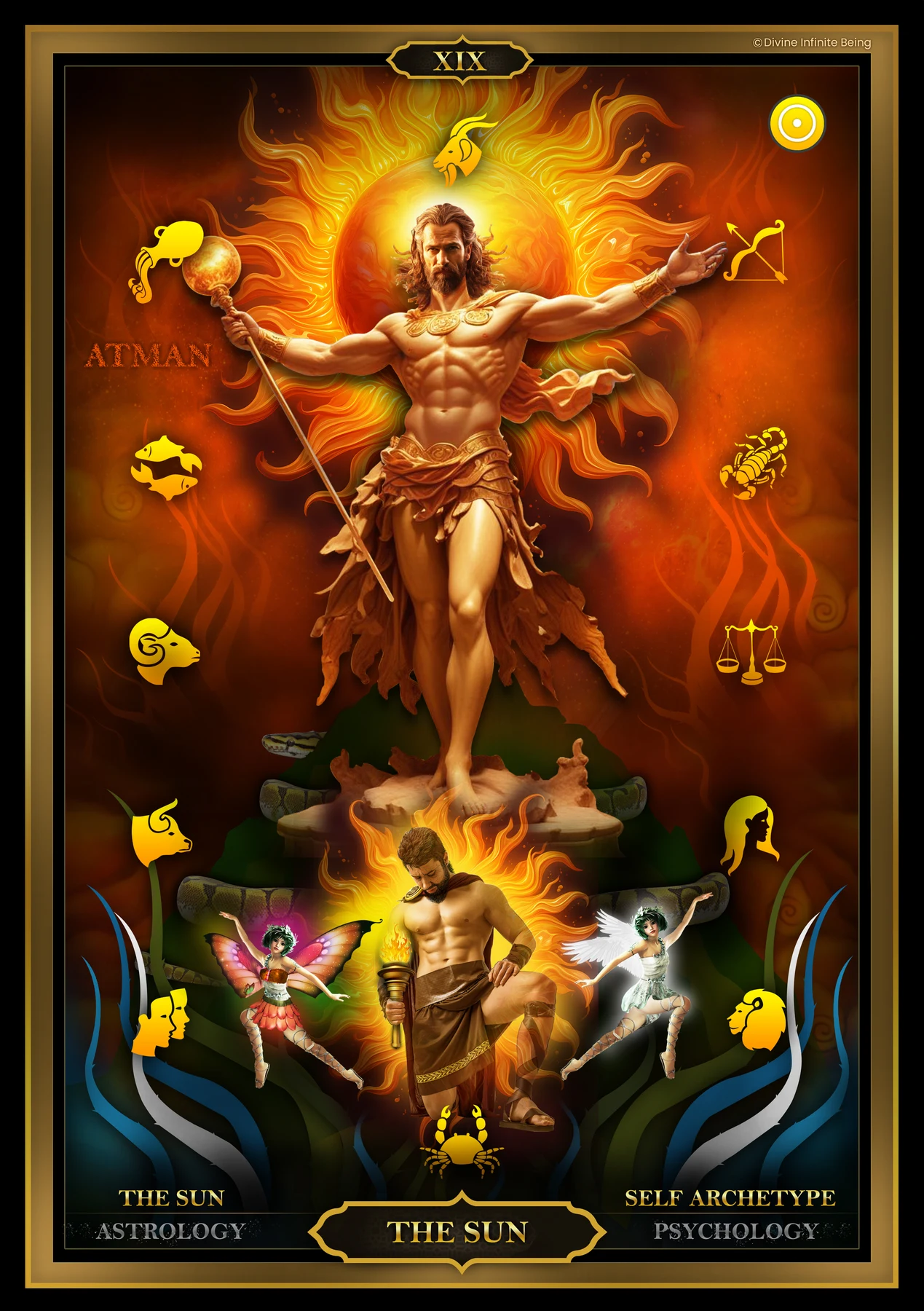
Helios stands at the center of the card with his arms held out to his sides. The gesture gives light as the Sun gives it, to every direction at once, as the Vedic Sūrya surveys the whole of creation (Central Doctrine, Chapter 29). His ornaments are golden and his garments flow, and the gold is the color the Upaniṣad gives the person in the sun, golden to the tips of his nails. The garments flow outward from him as the solar wind flows outward from the star. One hand holds a long staff that ends in a golden sphere. A sphere raised on a staff is the sign of an office held in the hand, and the office here is the one the Sun holds in the microcosm, the reference from which every measure is taken. The sphere repeats on the scale of the hand the disc that blazes behind him, and the glyph of the planet that the deck lists with the card is a third circle of the same figure, drawn as a sign.
The disc behind Helios is enormous, and swirling golden and orange flames run across the whole upper field of the card. The disc is the visible body of the god, the star that holds about 99.86 percent of the mass of its system, and Helios stands before it as the god stands before his body. The picture puts the body behind the god and the god in front, in the order of the layered ontology of the Central Doctrine, where the planet is the visible body of the god (Chapter 32, §32.5). The flames swirl as the star itself moves, in the convection of its outer layers, the different rates of rotation of its layers and the loops of its magnetic field. The Solar Logos is the intelligence of that motion and is not drawn.
Around Helios stand the twelve signs, Aries, Taurus, Gemini, Cancer, Leo, Virgo, Libra, Scorpio, Sagittarius, Capricorn, Aquarius and Pisces, drawn as glyphs. The ring is the Solar Ātman unfolded through the year, the twelve modes of the Sun in which its Self meets the living Earth (Chapter 6, section 6.3). Four of the twelve mark the turnings of the Sun's year. Aries begins at the vernal equinox, Cancer at the summer solstice, Libra at the autumnal equinox and Capricorn at the winter solstice, and the other eight stand between them in the fixed and the mutable modes. Each sign trump of the Greater Arcana shows one mode in a picture of its own (Chapters 17 to 28), and the ring on the Sun card shows the twelve together around Helios. The card gives the Sun no sign to stand in.
The word ATMAN stands at the left edge of the card, beside the god. It names the Self that the ring displays and the god holds at the center, the Self of the Sun and, by analogy, the Self known at the center of a human life, a center within the Center (Chapter 2, section 2.3). The Upaniṣads use the word for the pure and radiant essence of a person, the part that is whole before any of its works, and the card prints it beside the god whose light reaches every sign of the ring. Each of the twelve modes shows one part of what that whole center holds. The Ātman of a person is known the same way, through the twelve houses and signs of a nativity, each a region in which the one center is lived.
The feet of Helios rest on a platform of raised stone, and a great serpent is coiled around it beneath him. The card draws a god upon a station that is not himself. In the School's reading the platform is the station of reception, the Earth, where the light of the Sun is received and resolved into the life of a world (Central Doctrine, Chapter 29). The Sun does not rise upon it, and the station turns toward him. The card does not name the serpent. The Devī Bhāgavata calls the Sun the Manifester of Time, and the School reads the coil, as its own reading, as the year turning back upon itself under the god who measures it. A serpent also sheds its skin and lives on in a new one, and the coil beneath the god shows the renewal of life that each turn of the year brings under the Sun: the seed in the ground in winter, the green field of spring and the harvest that returns the seed to the ground. The stone holds still and the serpent moves around it, the fixed station of the Earth and the cycle of seasons that the Sun draws across it.
Prometheus kneels below Helios on one knee with his head slightly bowed, a flaming torch in his hand, and an aura of golden flames surrounds him. The note of Servius puts the torch at the wheel of the Sun, and the card places the wheel above and the torch below. In the School's reading the wheel of the Sun in Servius is the wheel of the twelve signs that Sūrya–Nārāyaṇa drives, with twelve spokes turning time (Central Doctrine, Chapter 29), so that the ring on the card is that wheel and Prometheus takes his torch from the year itself. What he carries down is then the knowledge of the signs in their order, the astrology that Servius says he taught. Servius says that he went up to heaven, and in the School's reading the raised knee is the step of that ascent, taken by one who now kneels below the god he went up to. The light that he holds is the light of the Sun's instruction, delivered whole to the station and resolved at the hand that takes it.
The bowed head and the bent knee are the posture of a receiver. Prometheus holds the fire with his face turned down from its source. The card draws the gift as received from above and handed on below, and the bearer keeps its order by kneeling beneath the god who gives it. The aura around him is golden, the gold of the ornaments of Helios. The fire he brings to humanity is knowledge, the arts and the waking of human consciousness, and in the School's terms it is the light of the Sun turned into something a human life can use, an instruction admitted at one station and worked into a craft, a thought or a vocation.
The Hermetic Qabalah gives the same order in its own map. The Golden Dawn sets the Sun at Tiphareth, the sixth sefirah at the center of the Tree, joined by paths to every other sefirah except Malkuth, the Earth, and the light of Tiphareth reaches Malkuth through Yesod, the sphere of the Moon. The reference stands at the center of the whole and the station of reception receives it through a medium, which is the School's teaching of the Moon as the reflective medium of the microcosm (Chapter 8). On the card the medium is drawn as a person, the Titan who carries the fire down, and the Theurgist takes up the same office when he keeps the Sun's Logos intact in a life (Chapter 9).
Three kinds of light stand one above another in the picture. The disc is the light of the star as a body, the god before it is the intelligence that the Solar Logos names, and the torch in the hand of Prometheus is the light that carries the instruction down to a station that can receive it. The ring of the signs is the order of the year, which the light carries. The three match what the Central Doctrine says of the Sun: that it is a star with a body of mass, that its consciousness is the Solar Logos and that its light is its integrated state encoded and sent out (Chapter 29 of that work).
The winged twins of Gemini dance at either side of Prometheus in their butterfly transformed form as fairies, with their arms stretched out, in the gesture of the god at the center repeated twice at the lower scale and in motion. They are Castor and Polydeuces, the twins of the constellation, a mortal brother and an immortal one who share a single life by turns, and the School reads them as the temporal self and its eternal Double (Chapter 19, section 19.2). The Greek word for the soul, psychē, is also the word for the butterfly, and Aristotle uses it so in the History of Animals (V.19), where he describes the insect as generated from caterpillars that grow on green leaves. The School reads their butterfly form as the change of form of the soul in the light of the Sun. They dance, and the dance is the joy and the freedom of a soul that has received the light, the response of the receiver once the fire has reached the station. Their arms are held out like the arms of Helios.
The lower background runs flowing shapes of green, blue, black and white around the figures. In the School's reading these are the colors of the Earth that receives the fire: the green of living ground, the blue of water, the white of cloud and ice and the black of the night sky behind them. The colors of the card divide at the platform. Above it the field is gold and orange, in the disc, the flames and the ornaments of the god, and below it the field is cool. The warm colors belong to the place where the light is made and the cool ones to the place where it is received, and the torch and the flames around Prometheus are the fire that the lower half has taken from the upper.
The glyph of Cancer stands at the bottom center of the card, under Prometheus. Cancer begins at the summer solstice, where the Sun stands farthest north and turns back, and the word tropical belongs to this turning (tropē). Porphyry reports in On the Cave of the Nymphs that the theologists call Cancer the gate through which souls descend and Capricorn the gate through which they ascend (trans. Thomas Taylor). The fire on the card descends through the gate of descent and the glyph of that gate is the lowest mark on the card, and Capricorn, the gate of ascent, is one of the twelve of the ring. Cancer stands at the foot of the card and again among the twelve of the ring.
The numeral XIX places the card between the Moon card (XVIII) and the Rising (XX), and the Rising is the gate pair of the Sun (Chapter 16). The deck lists the glyph of the planet with the card, a circle with a point at its center, and the glyph is the figure of a center and its circumference together, the Mandala that Jung read as a figure of the Self (Chapter 2, section 2.3).
7.4 The Tradition
The Golden Dawn and the Thoth deck assign the card to the Sun, as the School does. Aleister Crowley's Atu XIX draws the signs of the zodiac around the whole picture in their normal position with Aries rising in the east. The School keeps that ring and the order of the signs in it. The figures of the Thoth card are Crowley's and Lady Frieda Harris's own, and the figures of this deck are the School's (Chapter 1, section 1.9).
Paul Foster Case, who taught the Tarot in the Builders of the Adytum, wrote of the human features of the Sun in his Key 19.
"The human features indicate that the sun is no inanimate object, but a living, conscious Intelligence." — Paul Foster Case, Highlights of Tarot (Builders of the Adytum, 1989), Key 19
The sentence agrees with the School's teaching of the conscious Sun, and the Divine Arcana carries the same teaching in its figure of Helios, a god with a body behind him. Lon Milo DuQuette, in his commentary on the Thoth deck, joins the perpetual light of the Sun to the continuity of consciousness. His sentence agrees with the Devī Bhāgavata line that the Sun has no rising or setting and with the keyword of Continuity given in section 7.5.
The traditional readings of the card are joy, vitality, clarity and success, and the School keeps them in the two octaves of the planet. In the lower octave they describe radiance mistaken for reference, a center that needs to be seen before it can know itself, and a vitality that narrows into display. In the higher octave they describe the quiet knowing of a person who stands in a full center, gives light without keeping account of it and is steady when no one is watching. The School reads the card as the reference of a life and never as a card of fortune.
The reading of the card as the identity and personality of the querent follows the popular reading of the Sun sign, which WaveForm Astrology finds at once too large and too small (Chapter 9 of that work). It is too large because it gives a twelfth of humanity one character, and too small because it turns the center of the solar system into a list of personality adjectives. The School keeps the part of that reading that is true, that the Sun names who a person is at the center, and corrects the scale. The ego holds a partial picture of that center.
The School keeps the assignment to the Sun, the ring of the twelve signs, the face of a living Intelligence and the sense of a giving light. It adds Prometheus with the torch that Servius lights at the wheel of the Sun, the word ATMAN, the golden person and the serpent coiled beneath the god. It sets aside the Thelemic doctrine of the Aeon that Crowley attaches to the card. The letter that the Golden Dawn and the Thoth deck assign to the card stands in Appendix D, where the ledger of letters is kept for comparison.
7.5 The Psychology
The deck gives the Sun two words, Atman as its keyword and Self Archetype as its psychology. They name one fact from two sides. Atman is the word of the Upaniṣads for the Self at the center of a person and, in the School's use, of the Sun at the center of a system. The Self Archetype is Jung's name for the center and the whole circumference of the psyche, the totality that holds the conscious and the unconscious (Chapter 2, section 2.3). The Self is the face the Sun turns toward the psyche, in the layered ontology of the Central Doctrine (Chapter 32, §32.5). Jung describes the work of becoming whole as individuation, the integration of what the ego had left outside its circle, and the Self is both the goal of that work and the center that guides it. The deck's psychology names wholeness, integration and the realization of one's true nature in one archetype, and the card draws them in order: the whole Self at the center in Helios, its twelve modes in the ring, and the soul that has received the fire dancing at the foot. WaveForm Astrology maps the mandala of Jung onto the solar microcosm, with the Sun at the center and the ochēma at the circumference (Chapter 10, §10.5.3), and the ring of the twelve signs around Helios is that circumference drawn on a card.
The Self is a different thing from the ego. The ego is the center of consciousness, and the Self is the center of the whole. WaveForm Astrology states that the solar center is not the ego, and that the common failure of the solar function is the substitution of surface desire for the deeper reference (Chapter 9 of that work). A person reaches the solar center by way of the observing "I", which is a window onto it and never the center itself (Central Doctrine, Chapter 29). The signature of the solar center is a quiet knowing that what is intended is already real in a meaningful sense, with no scanning for reasons that it might fail. The failure markers are the inverse of the signature: scanning, pursuit in place of ownership and excitement in place of knowing.
Four keywords are added to the two of the deck. Radiance names the giving of light in every direction, the work of Helios with his arms held out, and it names the Leo lesson of WaveForm Astrology, that radiance is no reference. Reference names the Sun's office in the microcosm, the invariant frequency against which everything else is measured. Gift names the torch that Prometheus brings down and the light that the Sun gives to every life of its domain. Continuity names the Sun that has no rising or setting.
The archetypal register of the card is the Sun's field. The archetypal astrologers set the Sun among the personal planets as the light of consciousness and the principle of individuation, the self growing toward its own center. Its field takes in identity, vitality, purpose, creative power and authority, and its stories are the hero's journey, the divine king and the divine child. Its names in the traditions are Helios, Apollo, Ra, Sūrya and Sol, its materials are light, fire, heat, gold and the day, and its persons are kings, leaders, performers, athletes, artists and heroes. In the higher octave the register is radiance, steadiness and the giving of a person who stands in a full center, and in the lower octave it costs the person a need to be seen. The field is Keiron Le Grice's, set out in The Archetypal Cosmos (Floris Books, 2010), and the reading of the Sun as the reference of the microcosm and the Self of the Solar Ātman is the School's.
7.6 In the Rite and in the Decans
The Sun stands at the gate of Spirit at the top of the Decagram, and the Rising, Pluto's trump, stands opposite it at the bottom as the other trump of that gate (Chapter 6, section 6.4). In the Grand Invocation the card answers to the seventh Name, Helios, the body of light and the solar center (Ritual Praxis and Instruction, Chapter 29). The Name is a presence addressed in the rite and is no label for the card, and the table of Chapter 6 gives the cards of all the Names (Chapter 6, section 6.9). The Name that follows Helios in the rite is Protogonos, the first-born of the Orphic egg, and the Fool answers to it (Chapter 14). Prometheus is the patron of the fourth grade, the god who brings the fire of the Sun to the earth, and the work of that grade is the invocation of the nativity on the birthday (Ritual Praxis and Instruction, Chapters 56 and 57). The rite is given in Ritual Praxis and Instruction (Chapters 25 to 29).
Ritual Praxis and Instruction reads the card at the Name of Helios in the order of the Seed and the Egg: the ochēma is present about the theurgist after the Name of Hecate, the seed is lit within it at Helios, and the Sun card pictures the seed lit with the circle of the signs about it (Chapter 29, §29.2.6). The card adds two things to that place. The god stands in front of his own blazing body, which gives the theurgist the picture of the rite's teaching that Helios is known from within the light and is never an object seen in front of the eyes (Chapter 29, §29.2.3 and §29.4.5). Prometheus kneeling beneath the god with the fire in his hand gives the posture in which the light, once known, is carried down into the body and the life, which the closing of every rite completes (Chapter 31, §31.7.6). The rite of Helios asks the theurgist to identify with the body of light, and the Central Doctrine gives the doctrine of that identification (Central Doctrine, Chapter 31, §31.5.4). The Central Doctrine also sets the card beside the Name in the order of the rite: the Sun card pictures the planet at the center of the ten, and in the rite Helios is invoked as the god whom the Platonists called King of Mental Fire, with the card as the picture in which he is seen (Central Doctrine, Chapter 42, §42.11.8; Chapter 29, §29.13). Prometheus on the card is the step that the identification needs after it is made, the fire of that King carried down by a kneeling figure into knowledge and craft. The School Layman Explanation gives Helios as the seventh Name and the solar seed, and its sentence "Helios is the sun, and we are also the sun" is the sentence the card draws, the god at the center of the system and the person at the center of a life (§II.7). In WaveForm Astrology the same center is the solar operator, the key frequency of the chart to which every other operator is tuned (Chapter 10), and the ring of the signs on the card is the twelve modes in which that one frequency is held.
Five small cards stand in the Sun's decans, and each is the Sun in one sign over a station of ten days, a daemon in presence of the mundane relation (Chapter 5; Ritual Praxis and Instruction, Chapters 54 and 55). Each of these decans opens two gates, the gate of the sign's element and then the Gate of Spirit, in the order of the elemental hierarchy (Chapter 4, section 4.7). The Three of Wands, Virtue, is the Sun in Aries from 31 March to 10 April, and the daemon is Arete. The Ten of Swords, Ruin, is the Sun in Gemini from 11 to 20 June, and the daemon is Ate. The Eight of Disks, Prudence, is the Sun in Virgo from 23 August to 1 September, and the daemon is Epiphron. The Six of Cups, Pleasure, is the Sun in Scorpio from 2 to 11 November, and the daemon is Hedone. The Four of Disks, Power, is the Sun in Capricorn from 10 to 19 January, and the daemon is Bia. Each force has a binding face and a freeing face, and the Decan Year brings each to neutral without erasing it (Chapter 5).
The five stations stand 70, 70, 70, 70 and 80 degrees apart, and Chapter 4 gives the arithmetic of the near-pentagram that they draw (Chapter 4, section 4.4). The Sun rules no decan in Leo, whose three decans belong to Saturn, Jupiter and Mars, and it holds the second decan of Aries, where it is exalted. The sign trumps of the five stations are the Emperor, the Lovers, the Hermit, Death and the Devil (Chapters 17, 19, 22, 24 and 26). The small cards stand in Chapter 34 (the Three of Wands), Chapter 36 (the Ten of Swords), Chapter 37 (the Eight and the Four of Disks) and Chapter 35 (the Six of Cups).
In the circuit of a station the sign trump, the planet's trump and the small card of one decan are taken together. The circuit of the second decan of Aries is the Emperor, the Sun and the Three of Wands, and the circuits of the other four stations follow the same form with the Lovers and the Ten of Swords, the Hermit and the Eight of Disks, Death and the Six of Cups, and the Devil and the Four of Disks.
7.7 Scrying
The scrying of this card takes between twenty and forty minutes, and the method is given in Chapter 38. The student begins by finding the Sun in the nativity: its sign, its house of the chart, the aspects it receives and the mode of the sign, cardinal, fixed or mutable. The stones and incenses for the work are given in Ritual Praxis and Instruction (Chapter 22, §22.6 and §22.7). The student sits upright in daylight with the card at the height of the eyes and does not look at the visible Sun at any point of the scry.
The gaze begins at the ring of the twelve signs and goes once around it. It moves inward to the disc and the flames behind the god and rests on Helios, the staff and its golden sphere, and the word ATMAN at the left. It moves down to the platform and the serpent, and then to Prometheus, the bent knee, the bowed head, the torch and the aura of golden flames. It passes to the twin at the left, then to the twin at the right, and it ends at the glyph of Cancer at the foot. A full scry follows this order once and then returns up the card by the same figures.
The ring takes the longest. The twelve glyphs are read one at a time in the order of the year from Aries, and the student rests at each until the season it begins can be named, such as the vernal equinox at Aries and the winter solstice at Capricorn. The other figures need less time, and the gaze leaves each when its image holds still.
A student whose Sun is in a fire sign can begin at the disc and the flames, and a student whose Sun is in an earth sign can begin at the platform and let the stone steady the gaze. A student with the Sun in air can begin at the ring and let the glyphs be read one by one, and a student with the Sun in water can begin at the lower background and let the shapes flow around the figures.
Five questions move the scry through the layers of the card. The first asks what in the student's life is measured against something that does not change when the weather of the day passes, and what that fixed thing is. The second asks where the student gives light and where the student begins to look for applause. The third asks which season of the year the student was born in and what that mode of the Sun asked of the student's own center. The fourth asks what fire the student was handed, by whom, and what has been done with it since. The fifth asks which of the two twins the student is nearer today, the mortal brother or the immortal one, and what the other asks.
The scry closes on the glyph of Cancer. The student records the order in which the figures appeared, the one that drew the gaze first and the one that drew it last, the sign and the house of the chart in which the Sun stands, the answers to the five questions and the one question the card left open. Sensations of warmth, of weight or of quiet in the body are recorded beside the images. The student returns to the card at a later sitting with the open question answered or changed (Ritual Praxis and Instruction, Chapter 2).
7.8 The Throw
In a reading the Sun names the class of experience in which a center is known and its light is given. The sky fixes the class, and the person chooses the thread within it and the octave in which it is lived (Central Doctrine, Chapter 18; Chapter 32, §32.9 and §32.10). The thread is the particular center a person keeps, a vocation, a household, a craft or a conviction, and the octave is the manner of keeping it, in display or in quiet knowing. A person who stands in a full center, a source of light for others, a gift given without return, a steady reference that does not change with the day, the one in a household or a work who is the center of it and a season of clear light all belong to the class. The card is never reversed, and its two octaves are read from the question and the neighbors.
In the lower octave the card is radiance mistaken for reference. A person needs to be seen in order to know that the center is there, recognition becomes the measure, and the center scans for the evidence of applause. The warmth of the card then narrows to display. In the higher octave the card is the quiet knowing that needs no witness. The person gives light without counting what returns, holds the reference when nothing is shown, and is the one against whom the others in the matter are measured.
As a person the card names the one who is the center of a family, a work or a household, the teacher who gives without keeping count, the elder whose steadiness others measure themselves against, or the child who is the light of a household. As a time it names a day of full light, the season of the Sun's height and the long daylight of a matter that is plainly in view. As a place it names the center of a home, a courtyard open to the sky and the room where the light is best.
The four added keywords sort the range of the card in a reading. Radiance asks who is giving light and whether the giving asks for return. Reference asks what does not change in the matter and whether it has been named. Gift asks what has been handed down from above and what is being carried down. Continuity asks what has been constant without interruption and for how long.
In the three-card spread the card can fall in any position. As the situation it names a center that is steady around the question, and the question is who stands in it. As the challenge it names the need of recognition that mistakes display for the center, and the question is whether the center would remain if no one saw it. As the outcome it names a center that has been found, a matter that comes into full light, a gift given or a steadiness that others have begun to measure by.
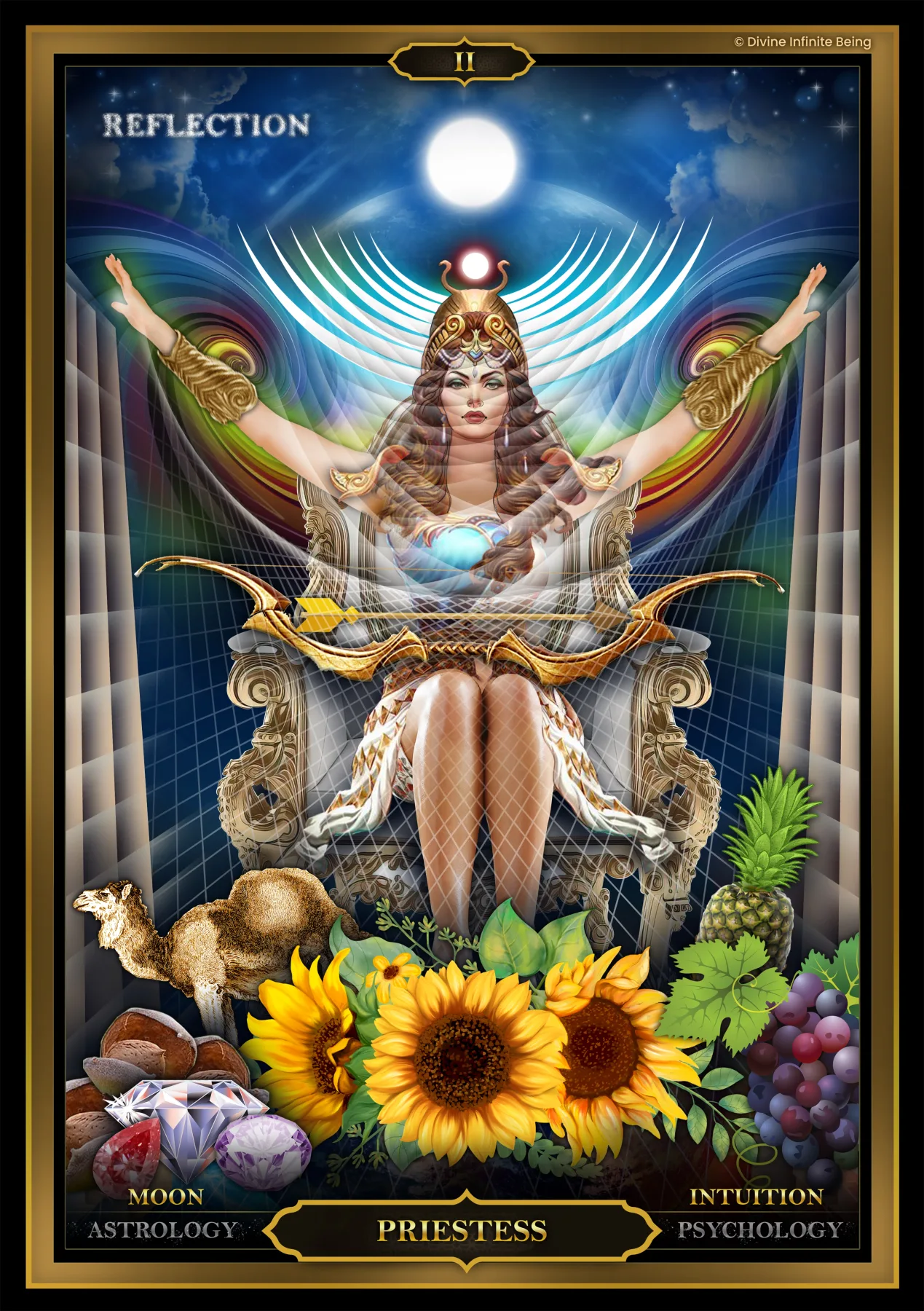
The Rising is the gate pair of the Sun, the Sun as the reference of every measure and the Rising as the renewal of the substrate beneath it (Chapter 16). The Priestess is the Moon, the other luminary, and the pair shows the reference beside the medium that reflects it (Chapter 8). The five small cards of the Sun's decans name five mundane forces of the one reference, Virtue, Ruin, Prudence, Pleasure and Power, each the Sun at work in a sign, with the sign trump beside it as the second parent (section 7.6). Strength is the trump of Leo, the sign the Sun rules, and a spread that draws it beside the Sun shows radiance at home in its own sign (Chapter 21). The Emperor is the trump of Aries, the sign in which the Sun is exalted, and the pair shows the center renewed at the spring equinox (Chapter 17).
In a worked example, a woman who has run a small school for fifteen years asks whether to hand it on. The Sun falls as the situation, the Four of Disks as the challenge and the Rising as the outcome. The Sun names the school as a center that others have measured themselves against for fifteen years. The Four of Disks, Power, is the Sun in the third decan of Capricorn, and its title names the mundane force of power, with the Sun's reference held in a sign of earth. The Rising names the renewal that follows when an order is let go. In the higher octave the reading is to hand the school on as a gift, in the manner of Prometheus, and to stand in the center that remains without it. In the lower octave the reading warns that she keeps the school in order to be seen. The spread names the class of experience and leaves the day and the choice to her.
The card is misread when it is taken for confidence, success or the ego. It names the reference of a life and the light that is given from it.