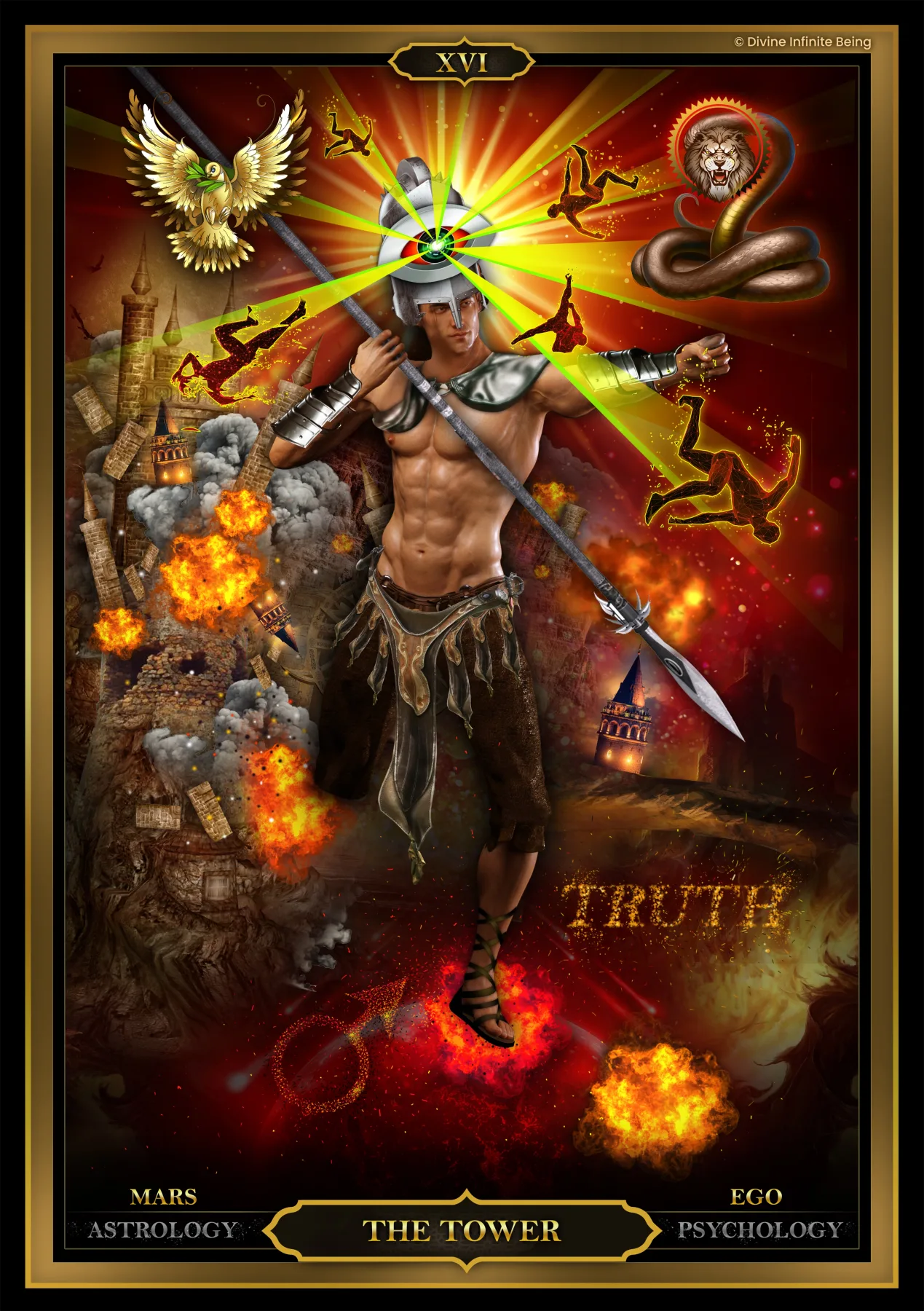
The theurgist who knows them in vision can meet them in time, and through them come home to our Divine Infinite Being.
Central Doctrine, Chapter 32
Near at hand
Like many other practitioners of theurgy in its various forms, I always had astrology near at hand, though for most of my life it never held a central place in my work. I knew my natal chart, and now and then I watched videos about my transits. In casual conversation with friends about their Sun, Moon and rising signs I would often look up their placements and give them a short, pointed reflection on what those placements meant.
I had practiced Tarot for many years, and the archetypal resonances of the signs and planets ran through every reading I gave.
Among the ritual communities I spent time with, planetary invocations were performed without reference to the transits of the day or to anyone's nativity, except when someone chose an auspicious date for a ceremony. Our rituals were cosmic in their reach, and they were cut off from the living rhythm of the sky. A Saturn rite was performed in the same way whether Saturn was pressing hard on the operator's Sun that month or passing quietly through a far corner of his chart. Nobody I worked with asked that question, and for many years I did not ask it either.
My reading gave me a reason for the distance. In De Mysteriis I had found a thinker who acknowledged the legitimacy of natal astrology and still held it at arm's length, below the higher aims of theurgic ascent. Plotinus asked in his treatise on whether the stars are causes (Enneads II.3) and answered that the stars signify.
In the Platonic picture I still held, the planets were gateways the soul passed through on its way up, and I did not look for them in the days of my own life.
SpiritCon, 2020
The change came in 2020, while we were living in Saint Anthony, when I traveled to a spiritual convention in Salt Lake City called SpiritCon, where I had been invited to speak. Formal astrology, taught as a science in its own right, had first reached me the year before at a class of the O.T.O. body in Las Vegas, and I had found it very interesting, but its impact as an art came to me only with the full reading I received at that convention. There I met an astrologer named Tabatha Adams. I sat with her for a reading, more out of curiosity than expectation, and I expected an interesting hour and a few new thoughts about my chart.
What she revealed shook the foundations of my assumptions. She spoke into my life with a precision, depth and many-layered insight that I had never met in any reading of any kind. Through the symbols she was listening to the voice of the cosmos as it spoke uniquely through me, and she told me what she heard.
Until that day I had honored the planets in essence. I revered them as vast divine intelligences present throughout the world-soul, beings whose rhythms mirrored eternal principles and whose motions reflected archetypal truth. Through her I was shown that these same presences were involved in the pattern of my every joy, struggle, turning point and initiation. She was showing me the living script, in which each planetary movement was a precise marker of the when, where and how of my lived experience.
What I had approached philosophically and liturgically for most of my life she approached technically, intuitively and personally, and she lost none of its sacredness in doing so. I had come to the gods through the temple, the invocation and the altar. She came to them through the ephemeris and the wheel of the chart. I saw that day that astrology could be at once a cosmic science and an immediate, intimate conversation with the divine.
For years I had watched for synchronicity in my own life, the meaningful meeting of an inner event with an outer one, and I taught it as a key to the rites. Astrology maps the timing of such meetings, and I had never taken the time to learn its tables and rules.
Her condition
Impressed by her insight, I invited her to collaborate. I was then building the divinatory curriculum of our School's mystery program, beside the theurgic ritual praxis and the training in Tarot divination, and I began to consider how astrology might enter it. I imagined Tabatha as a colleague leading the astrological part of that curriculum.
She accepted the spirit of the invitation and gave me one condition, which was non-negotiable. She told me, "If you're going to teach this, you must know it as deeply as I do."
I took her at her word. Meeting Tabatha's condition took me five years, and she is a teacher in our School today.
The full commitment
Directly after SpiritCon I made the full commitment to incorporate astrology in its full register into a ritual praxis that would put the theurgist in contact with their own nativity and with the living sky in its movement over time. I wanted the theurgist standing in the temple with the whole of the birth chart behind them, and with the planets of the present sky moving across it, month after month and year after year, so that every rite would be performed by a particular person under a particular sky.
My years of experimentation in the temple, my journal notes and my long study of the sciences all came together in that decision, as I mapped our ritual praxis together with the astrological sciences. The rites I had performed for decades gave me the operations, and astrology gave me the map of the person and the clock of the sky. Physics and the new science gave me the predicates I had already been testing in ritual.
I took all of this into the small temple in a room of my office at the back of the bank in Saint Anthony, and that room is where the work was done. I practiced there, journaled there, imagined there and crafted there, and day by day I tied the pieces together.
Surrendering to the path
So I surrendered to the path. I immersed myself in the works of Chris Brennan, Demetra George, Richard Tarnas, Alexander Boxer, Keiron Le Grice, Liz Greene and many others.
Chris Brennan's Hellenistic Astrology: The Study of Fate and Fortune (2017) took me back into the techniques of the astrologers of the Greek-speaking world, the whole-sign houses, the lots, the sect of day and night charts and the timing methods by which they followed a life through its periods. Demetra George's Ancient Astrology in Theory and Practice carried me through the same ancient doctrine as a working manual, sign by sign, planet by planet and condition by condition, and taught me to judge a planet by its strength and its circumstances in the chart.
Richard Tarnas opened archetypal astrology for me. In Cosmos and Psyche: Intimations of a New World View (2006) he followed the long correlations between the cycles of the outer planets and the movements of history, era after era, and in The Passion of the Western Mind (1991) he had written the history of Western thought that his astrology later answered. Keiron Le Grice, in The Archetypal Cosmos: Rediscovering the Gods in Myth, Science and Astrology (2010), joined that archetypal astrology to Jung and to the new physics, and he was the founding editor of Archai: The Journal of Archetypal Cosmology.
Liz Greene showed me the psychological depth a chart can hold. With Howard Sasportas she worked at the Centre for Psychological Astrology in London, and in Relating: An Astrological Guide to Living with Others on a Small Planet she read the chart as a map of the inner figures we meet again in the people we love. Alexander Boxer, in A Scheme of Heaven: The History of Astrology and the Search for Our Destiny in Data (2020), showed me astrology as the ancients practiced it, as a science of data and calculation.
Behind these modern authors stood the old ones our books now draw on. Ptolemy gave the art its classical handbook in the Tetrabiblos of the second century. Vettius Valens left in his Anthology the working notes of a practicing astrologer of the same century, with chart after chart from his own clients, and William Lilly wrote Christian Astrology in 1647, the great English manual of horary work. In the modern line stood Dane Rudhyar, whose The Astrology of Personality (1936) joined the chart to the psychology of Jung and whose An Astrological Mandala (1973) read the 360 degrees of the zodiac as phases of one cycle, and John Addey, who studied the planetary cycles as harmonics of the circle.
I studied the long history of astrology and its influence on civilization, and I uncovered layers of it I had never imagined. It began in the omen-watching of the Babylonian temple scholars, whose great series of celestial omens, Enūma Anu Enlil, set down in cuneiform what the sky foretold for the king and the land, and in the star-clocks of the Egyptian priests, who divided the night by the rising of the decans. The oldest horoscopes cast for single persons come from Babylon in the late fifth century BCE. It was carried through Alexandria, Rome, Baghdad and the universities of medieval Europe, and on through the Florence of Ficino, the Prague of Kepler and the Zürich of Jung. In Florence Marsilio Ficino, the translator of Plato and Plotinus, wrote his Three Books on Life in 1489, with its counsel on drawing down the life of the stars through song, image and the right hour. In Prague and Linz Kepler wrote Harmonices Mundi in 1619, setting out the harmonies of the planetary motions beside his third law. In that history I met Jung as a reader of the sky, and Kepler as an astrologer who cast charts all his life.
At first the art overwhelmed me, and even as a seasoned student of esoteric systems I found its complexity staggering, in the breadth of its techniques, symbols, mathematical structures, timing methods and archetypal interplay. It was a universe of systems, layered and interconnected, and it asked for rigorous intellectual work and intuitive attunement together.
Chart after chart
I began to read charts, my own first, and then those of my students, clients, friends and family, and of many of the employees in my engineering business who were willing to have their charts read. Some of these were people I had worked with for years.
Reading a chart was a different act from reading the cards. A Tarot spread shows the moment of the question, drawn from the deck in the reader's hands. A chart shows the sky of a birth, and the transits show that same sky moving against it year after year, so the reading reaches back into the person's past and forward into seasons not yet lived.
My years with the cards helped me greatly. The archetypes of the signs and planets were already in the trumps, and the decans were already in the small cards I had worked into the rite. What I had to learn was the arithmetic of the sky and the patience to follow a single pattern across many years.
It took nearly five years of relentless study and disciplined practice, chart after chart, transit after transit and pattern after pattern, before I began to feel solid ground beneath my feet. I let the logic of the heavens slowly rewire my inner vision. I kept notes on the charts as I had always kept notes on the rites, and my journals began to fill with aspects, houses and the dates of transits.
What Saturn taught me
During those five years Saturn taught me the virtue of the god of measure himself, the patience that finishes what it begins and holds what it has received. That virtue came to me as the shape the work pressed into me, day after day, until it became my own.
I had known Saturn for many years in the temple as the lord of limit, time and structure, the outermost of the planets the ancients could see. In the old astrology he rules Capricorn and Aquarius, he takes about twenty-nine and a half years to circle the zodiac, and the old authors called him the greater malefic, the planet of hardship and delay. In the study of the sky I met him as a slower teacher. A rite lasts an hour or two. A chart has to be read again and again against the years of a life, and a transit of Saturn can take many months to pass.
I now teach my students that the theurgist who keeps the planetary rites in their season, and lives between them in the light of what was received, finds the gods' virtues growing in them. Saturn's patience was the first of those virtues I saw grow in me.
The guardians and the daemons
The Twos of the small cards already stood as the guardians of the ritual set in our country-home temple. In 2020 we mapped them onto the Greek daemonic spirits, and we found perfect matches across their total mundane expression. The daemons, in the teaching of Iamblichus, are the intermediary kind that stands between the gods and souls, serving the gods and carrying their will into the world (De Mysteriis I.5 to 6), and in our teaching a daemon is a minister of the gods. In a planetary invocation the theurgist takes the shape of Mars. In the Calling of the Guardians the theurgist calls Kratos, the guardian of Fire, to his station, and Kratos unites with the theurgist's persona (Ritual Praxis and Instruction, Ch. 31).
Today the four guardians stand in our rite as Kratos at the station of Fire, with the Two of Wands, Dominion, and Eros at the station of Water, with the Two of Cups, Love. Eirene stands at the station of Air, with the Two of Swords, Peace, and Janus at the station of Earth, with the Two of Disks, Change.
The card titles are those of the Thoth deck, and the older Golden Dawn titles of the same four cards are Lord of Dominion, Lord of Love, Lord of Peace Restored and Lord of Harmonious Change. Kratos is the Greek word for might and sovereign strength, in Hesiod a child of the river Styx, with his siblings Zelos, Bia and Nike, who dwell always beside Zeus. Eirene is peace, one of the Horai, and Eros is the desire that joins what is apart. Janus, the two-faced Roman god of doorways, keeps the threshold of the year.
The same synthesis runs across the forty small cards and their daemons, and in the Central Doctrine we have written that it is unique to our School, the product of extensive research that matched each daemon to its card. The qualities of valor, swiftness and strength in the Seven, Eight and Nine of Wands are the forces of Alke, Hormes and Thrasos. The peace, sorrow and truce of the Two, Three and Four of Swords are the forces of Eirene, Penthos and Ekekheira. The full compendium stands in the Central Doctrine (Ch. 51).
Course material for the Academy
While I studied I wrote. I gave a great part of my time to translating the vastness of astrological wisdom into course material for the students who would join our Academy, and I worked to put it into a form that could be taught without losing its sacred intricacy. That material became the base of the astrology courses in our curriculum and of the astrology training series we offer free on YouTube, where we go much further into its history.
Since 2020 alone I have invested six figures in developing the artwork, websites and educational programs of the School. Our ritual praxis is taught in two languages at once, the language of the rite and the language of the sky, and since my turn to astrology in 2020 I have taught both.
Five to eight hours a day
The commitment I made after SpiritCon became a deeper commitment as a writer. From 2020 to 2022 I dedicated anywhere from five to eight hours every day to writing and research for the works of the School, on top of my work in the engineering business. Those hours went to the charts and the astrological authors, to the rites and the journals, to the sciences, and to the drafts and notes from which the School's books were built.
In the middle of those years I visited India two different times. On those visits I began to see the grand synthesis of East and West for what it truly was, under one model and under one sky. The gods of the Śākta and Śaiva temples, the Platonic gods of Iamblichus and the planetary gods I was now following through the chart stood together for me in a single picture, and the sky over India was the same sky I was mapping in my temple in Idaho. That synthesis, combined with everything else, led me to the final inclusion I found through Timothy Desmond and the Multiverse.
Old companions
The study was hard, and still something in it was familiar from the start. I had spent decades in ritual union with the planetary gods, invoking their higher intelligences and ascending through their spheres in ceremonial devotion, and so I found myself attuned to the language of astrology at once. I could feel it and interpret it from within. As I studied the symbols of the natal chart I was recognizing old companions, divine intelligences whose rhythms and resonances I had already traced in ritual and vision.
My training had carved a pathway of freedom through their forces, so that I could engage their earthly expressions without being bound by them. When a transit arrived I could meet it from inside a relationship long since begun. Astrology became the continuation of that relationship.
As I went on, the techniques I had struggled with began to show their deeper coherence, and they spoke with the same hieratic clarity I had met before only in the rites. The natal chart became a mirror of the soul's incarnation, a divine glyph of its descent, its trials and its return. Astrology had sat beside my theurgy for most of my life. In those years it began to interpenetrate it, and it showed me how fate, spirit and will move together in a rhythm that can be read, anticipated and, through sacred engagement, entered consciously.
The gods began to move
The planetary deities I had once invoked only in their transcendent, eternal forms began to move. They stopped standing apart as distant archetypes in still perfection and became dynamic, breathing presences, moving through the events of time and experience. What had been a one-way gesture, myself in the temple drawing the gods into the world through symbol and invocation, grew into a full psychodynamic relationship with these divine intelligences, carried on through the currents of my own fate.
Transits became living conversations, god speaking to god within the microcosm of my being. Each planetary movement came as a gesture, a voice, a summons or a challenge from a familiar presence, and I felt it in the texture of my thoughts, in the turning of events and in the timing of initiations. The gods played their parts across my psyche, my relationships and the long arc of my life.
When Venus squared Saturn, the weight of love's delay pressed into my life as an emotional difficulty that was truly a rite of temperance. It worked in me like a refining fire, building structure into my affections, and it taught me discipline, maturity and the value of timing. When Jupiter conjoined my Moon, an inner expansiveness opened across long-neglected chambers of the heart, with a quiet grace that nourished me.
Eclipses, which had once come and gone without my noticing, now tore open the veils of certainty and carried me across thresholds I had glimpsed before only in ritual vision. They unsettled me, and they left me more deeply aligned. Even the retrogrades, which I had once taken for disruptions, became spiral descents, invocations turned inward, in which reflection deepened, my picture of myself loosened and the inessential was cast off like dead skin.
Fate met face to face
The largest change was in how I stood toward fate. For most of my life I had treated fate as something to rise above. In those years I turned to meet it directly, face to face, eye to eye, like a god addressing another god. I entered the temple of the planetary cycles as its initiate, its lover and its priest, and I discovered that fate was a passage, and that the gods were there to take their shape in me.
I was called to rise to their summits and embody their highest natures, and also to engage the world of becoming, with its many terrestrial forms and the clash and convergence of their movements. I was to labor through their retrogrades, move in harmony through their trines and stand unwavering as they came into opposition. At times I stood again in the ancient world, when the gods still walked among us and every shift in the heavens reached into the moments of a life. Even when the weight of their relationships overwhelmed me, I knew I belonged to their company.
For years I had known, as lines in my books and as objects on my altar, the teaching of Plotinus, the Chaldean Oracles and Iamblichus that the gods have sown their signs and tokens, the sunthēmata, through the cosmos (Enneads II.3.7; Chaldean Oracles fr. 108). I remember the moment the teaching came alive for me in astrological form, when the sunthēmata I had known filling the earth began to shape the becoming of my own being. Through astrology I saw the presence of the gods I embodied in the rite extended, intensified and brought into fuller view on the earth, in the choreography of the planetary cycles.
My path is our School's path, and I teach it as three turns that a student may walk in the same order. I began where Plotinus stood, with an ascent away from fate. Iamblichus turned me toward the ascent that is completed only in the descent, in which the gods are met in the world as well as beyond it. The living sky turned me a last time, toward the recognition that the gods we meet in the rite are moving now, in their visible bodies, through the pattern of a life.
I rewrote my rituals
What had been a path of ascent became a dance, a participation in the celestial liturgy, and I rewrote my rituals. My theurgy became astrological and bound to the celestial imprint of my nativity, and the timing of transits became the timing of invocation. The hour of a transit to my chart became the hour of that god's rite.
My rites, once fixed in a symbolic order, began to breathe in rhythm with the sky, and microcosm and macrocosm began to move together in ways I had never imagined. The result was greater power and, deeper still, presence, an immersion in the full spectrum of divine manifestation.
The sky now showed me which state each rite asked for and when. A rite performed in the season of its god had more in it to hold, and holding it asked more of my attention.
In our School I keep Iamblichus's own estimate of astrology, as true and as subordinate to theurgy. The personal daemon is found through theurgy and is never read off the nativity, and no god is ever the cause of evil. In one place our School goes further than its teacher, and that place is astrology, the taking up of the natal chart and the planetary transits into theurgic practice.
To scholars of Iamblichus this may look contrary to his cautions. In the depth of our practice we have come to see it as a faithful development of his principles. I set out my reasons in the essay Iamblichean vs Astrological Theurgy, and they now stand in Chapter 32 of the Central Doctrine. There we teach that ritual unbinds and astrology maps the path of the unbinding, and we take astrology up into theurgy as the map and the clock of the ascent, while the agency of union belongs to the gods alone. A reading of the transits is no rite, and the timing of invocation by the living sky has its procedure in Ritual Praxis and Instruction.
The seed
From the start of my study I saw how the sciences I had loved for years and the methods of our School met the astrological sciences. Iamblichus worked within the cosmology of his time, and his astronomy was bound by the limits of ancient observation. He could not have known the planets as we know them now, as vast gravitating bodies circling the Sun, with physical characters that sit very close to their old meanings. He never saw the great red storm of Jupiter, wider than the whole Earth, or the architecture of Saturn's rings.
I used to picture Saturn sitting in our sky at the distance of the Moon. Its globe would be more than thirty times as wide in the sky as the full Moon, and its rings would reach across a great part of the heavens, and the thought of its size could stop me where I stood. Jupiter, whose volume is more than thirteen hundred times the Earth's, would be wider still.
The Sun holds about 99.86 percent of the mass of the solar system. Its gravity governs the orbit of every planet, and its light and its streaming wind bathe the Earth in the conditions of weather and of life. It is about a hundred and nine times the diameter of the Earth, and its body could contain some one million three hundred thousand Earths. To me this was physical revelation, the center the Platonists had honored, shown at its true scale. Plato called the planets the "visible and generated gods" (Timaeus 40c–d), and we take his sentence as the classical charter of our astrology.
Our meditation on the planets is built on this picture of their true size. I set it out in Preparing the Body and Soul for Celestial Contact, and we teach it as a practice of preparation, in which you hold the Moon as the lens through which each god's immensity is received (Ritual Praxis and Instruction, Ch. 23). Its theology is that each planet is the god itself, revealed in cosmic embodiment.
In the rite I had learned that the god takes shape in the theurgist while a state is held, and that holding it costs attention. In the chart I saw each planet as one of those same gods at work in a person, some easy for that person to hold and some costly. The Sun stood at the center of the chart as it stood at the center of my rite, and a transit read as a condition of the hour, asking the person to hold one state or another for as long as it lasted.
None of this was yet a written system, and it had no name. It lived in my journals, in the course notes and in the way I read charts for the people who came to me. Years of further practice and long work on the School's books lay ahead before those notes were gathered into the written form our students now know as WaveForm Astrology. The guardians, the daemons and the cards stayed in the temple and in our books of ritual and Tarot, and the method of the chart grew apart from them.
Conversations with Anibal
Over the years my friend Anibal Alvarez, a Thelemic magus, and I have talked about the stars more times than I can count. He has a gift for putting a thing in one line. "Astrology is data, intuitive in nature and mathematical in structure," he says, and as an engineer I have always liked that sentence.
Ages advance and change, and what changes is the form. The form taken by the ancient Babylonian astrologers was just as valid as the forms we take in today's age of scientific and technological advancement. Today we capture data on computers and have engines of artificial intelligence interpret it into useful information. In ancient Babylon they read the great cosmic computer of the Solar Ātman, interpreting its geometric calculations of meaning and significance as a science of divination, providence and fate.
Another of his sayings fit what I was living through in those years. "I like to see symbols as subjective when I am studying and objective when practicing ritual." At my desk, with the books open, the planets were symbols to be weighed and compared. In the temple, in the season of a transit, they were presences in the room.
The six-month challenge
Every people that has ever looked up into the night has felt the sky speak, and in our School we answer the old question of how the sky can be read in two ways, through history and through experience. The historical answer is the lineage I studied in those five years, from the Babylonian omens to the living wheel of today. The empirical answer is my own, and I give it to everyone who asks me.
When people ask me how I know astrology works, I tell everyone the same thing. Find a good astrologer, get your birth chart done and dutifully follow your planetary transits for six months, and keep a record of your days beside them. Even the biggest skeptic will find it impossible to deny the influence of the planets within our solar system on their conscious experience, if they will do this. Anyone skeptical enough to get into the argument really must do it before they dismiss it, and most everyone who has given the focus and time to investigate astrology in this way comes away persuaded.
I have put that challenge to every skeptic I have ever met.
Proof of Astrology
For doubters who want more than their own six months, I gathered real-life research into a long sequence of slides, and the slides grew into our Proof of Astrology videos. We keep them on our website, www.divineinfinitebeing.com, and on our YouTube channel. When I first presented the work of Gunter Sachs in those videos, I took his test results and his probabilities and turned each one into odds against chance, the one-in-so-many figures that anyone listening could hold in mind.
In the consulting room
Over these years I have sat with many clients. There are signs I have learned to listen for in consultation, and I have heard them from clients many times. I have watched a hard placement become a strength in my students over many years, as with Venus in Virgo learning to bind value, and I have watched a double reading of a chart settle a client's confusion many times. Each of those hours went back into my notes and from there into what I teach.